
The following is part of a work in progress for a project on health and fitness.
“Until you make the unconscious conscious, it will direct your life and you will call it fate.” -Carl Jung
I was originally going to list this first enemy last (for dramatic effect). But I’ve instead listed it first because it is so important and because the other enemies feed off it.
We like to think our thoughts and our decisions are our own. The reality is, for the most part, they are not.
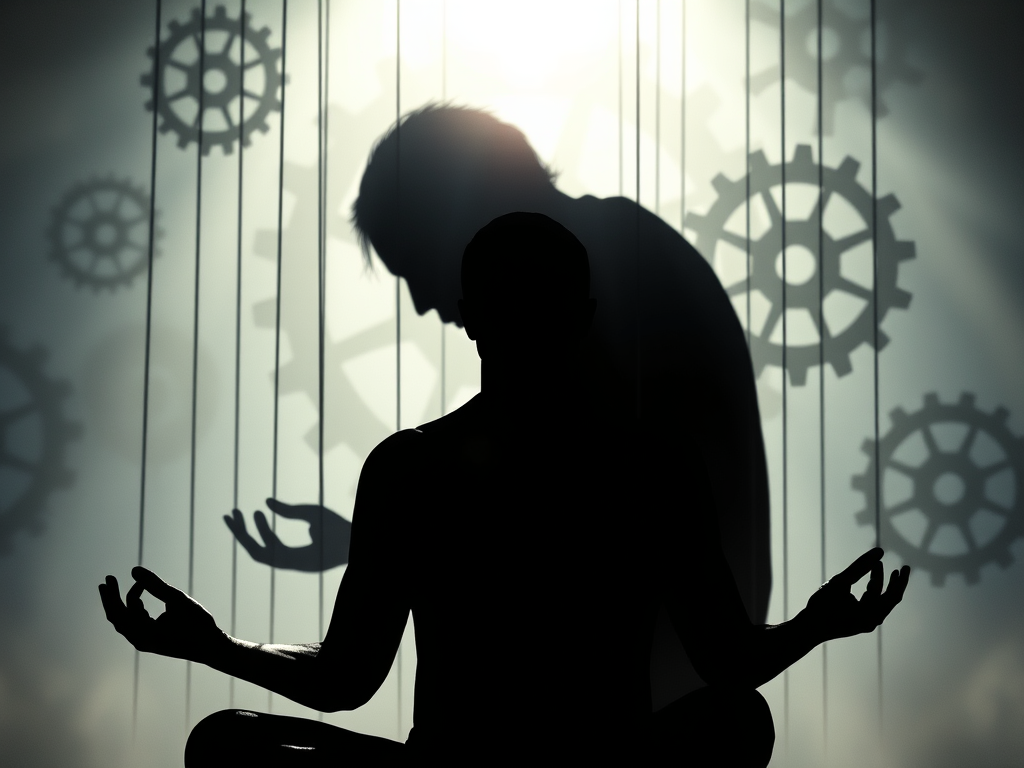
We are driven and, to a large extent, controlled by our unconscious impulses. Evolutionary reflexes that push us to avoid the uncomfortable, escape the painful, and seek out what feels good. Our biological wiring acts like an invisible puppeteer, pulling the strings that steer you to skip that workout or reach for that ice cream, even if at times you are in tears because you want so badly to get into shape. You want to do the right thing, but those unconscious impulses are powerful, extremely powerful, and they are in the driver’s seat.
This is a very difficult concept for us to accept. It is a thought that is uncomfortable, threatens our ego, and ruffles our very perception of reality. It challenges our notions of who we are and even the nature of life itself. (No wonder we don’t like to even consider this.)
It would be tempting to reject or reflexively (unconsciously?) stick our heads in the sand and pretend these unconscious drivers aren’t real. That won’t help anything. Rather, we need to embrace it as part of the human experience; as part of our personal human quest in this life to overcome the baggage of our inherent human flaws and sculpt ourselves into the best version of us that we can be. That quest is a gift. (But more on that in another post. – see religion) (See Rocky and other articles, posts on this)
So how does that invisible puppeteer, the unconscious, control you? It has several tools at its disposal. One way is that those unconscious impulses manifest physically. If the thought of going to the gym makes you nervous, or you really want that ice cream, there are physical actions that occur in your body – often without you knowing – that influence your thinking. Your heart races, your blood pressure increases, your breathing quickens, your muscles tense. It is mental discomfort manifesting as very real physical discomfort that compromises your thinking and pushes you toward an action (usually seeking comfort).
The tools aren’t just physical. Those unconscious impulses also attack your mind, bombarding it with mental messages, obsessing over things, providing anxiety-ridden narratives and stories that justify a way out.
Both of these sets of tools – the physical and the mental – subconsciously push you toward an action (quitting or caving) that you may not intellectually want to do. They act as irritants, much like an itch that builds and builds until you break and scratch it.
The more this happens, the harder things get. Stress manifests as tense, tightened muscles that often stay that way without you knowing, altering how you feel until you actively work to alleviate it. Your reflexes and impulses reinforce wiring and behavior so certain reactions become automatic, even if intellectually you don’t want to react that way.
Without exercising our mindfulness muscle, these unconscious drivers never come to light. That’s why simply doing physical exercises isn’t enough. We need to actively put in effort to work on our awareness and mindfulness, to make the unconscious conscious, if we’re going to successfully navigate our fitness journey. The more we can do that, the more we can wrest control from our reflexive puppetmaster. But it takes work.
There was a time I probably would have been the last person anyone would expect to do meditation. And when I talk about it with some people, I sometimes harken back to that, and a part of me still feels embarrassed of the words coming out of my mouth. I understand it sounds on the surface to be all woo woo. But the benefits are very real.
Meditation can help you grow your awareness of the monkey mind; that voice that bombards you with reflexive, instinctual messaging. The constant talk in your head. The more you meditate, the more you recognize that voice as just an animalistic reflex, the more you build that awareness muscle, and the more you begin to take control of your reaction to it.
Body scan meditation is a real eye-opener. In a body scan meditation, you mentally focus on each part of your body, and you work to relax each body part. The first few times you do it, really do it, it is shocking when you discover how tense many of your muscles constantly are without you knowing it, and how the body holds tension in various places, and how that constant, unconscious tension can impact how you feel.
And then there are ultras. I’ve often described ultras as meditation on steroids. It is a profound exercise of you versus your monkey mind. Deep into an ultra, your lizard instincts are on overdrive. The signals from your body and the voices in your head are screaming at you. But your conscious, analytical self – if you can cultivate it – understands the situation and that you can do this. It is a constant battle between the unconscious puppeteer and your conscious self. You are thrust into a space between impulse and action. And if you can tame the impulse, you can control the action. An ultra shines a spotlight on that moment, but it really is a battle we are in every day of our lives.
The journey toward mastering these tools is riddled with failure. And your instincts will tell you to avoid failure. But don’t. Constant exposure to this failure builds experience. That growing experience helps sculpt us into something greater, something stronger. Something closer to being a master of ourselves.